EPEA-BA
From Error Propagation to Efficient and Accurate Bundle Adjustment
The arXiv preprint and open-source code will be available soon.
Motivation
Bundle adjustment (BA) refines cameras and 3D points together by minimizing reprojection error. Their coupling makes the global linear solve expensive on large reconstructions. Both elimination orders give the same exact step on a common identifiable linearization. With a cheaper approximate solve, the order determines which variables inherit the remaining update error.
Theoretical Findings
- Forward elimination
- Eliminate points first. An error in the reduced camera solve passes into the 3D points when they are refitted across views.
- ex = −V−1W⊤ec + V−1sx
- Reverse elimination
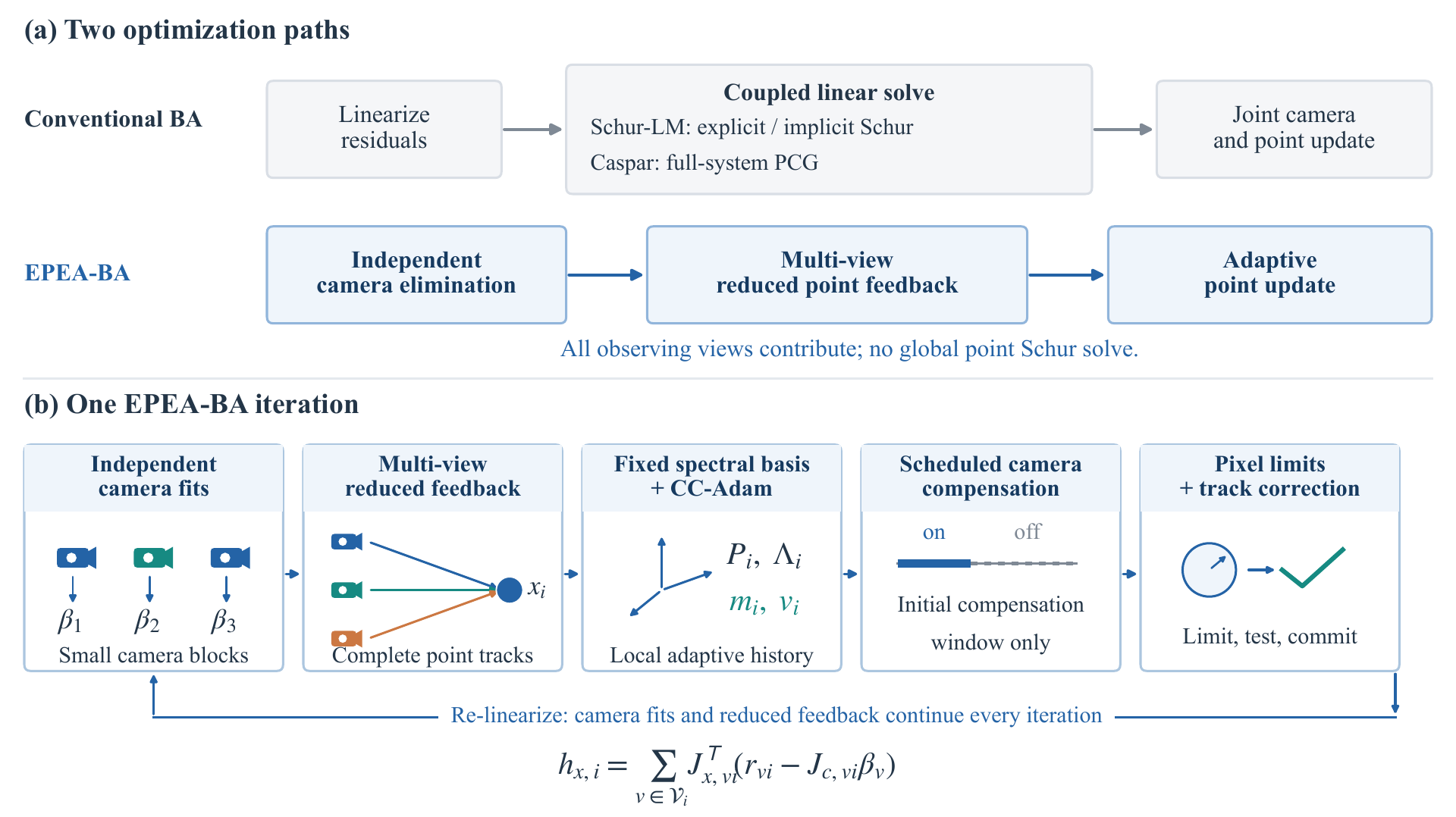
- Eliminate cameras first. An error in the reduced point solve passes into each camera through the points it observes.
- ec = −U−1Wex + U−1sc
On a fixed linearization with positive definite camera and point blocks, U and V are those blocks, W couples them, e denotes an update error, and s denotes a conditional-fit defect.
Geometry and nonlinear risk
In each receiving mode, the source image response is divided by the Jacobian’s singular value. An incomplete fit adds a term scaled by its inverse square. Amplification depends on which weak directions the error excites. In one view, the point shift that cancels a small rotation scales with camera-to-point distance and the rotation component perpendicular to the viewing ray. Nearly parallel rays constrain depth weakly. If an update drives the depth toward zero, perspective division can amplify the nonlinear error enough to reverse a predicted decrease.
Reduced feedback and local recovery
Camera elimination removes the residual component explained by retained camera motions and preserves feedback from every view of a point. On a fixed model, a local self-curvature update of size η multiplies each error mode by 1 − ηλ, where λ is the mode’s reduced curvature relative to point self-curvature. When cameras can nearly compensate the point motion, λ is small and recovery is slow.
We also quantify the objective cost of deferring camera back-substitution. On a fixed affine model, point updates driven solely by reduced feedback follow the same trajectory across camera-compensation schedules given identical initial point states, optimizer histories, and point schedules, with point steps committed as proposed.
Method
EPEA-BA uses reverse elimination to keep feedback from all views of a point while replacing the global solve with local updates. Curvature-corrected Adam (CC-Adam) applies a closed-form correction to Adam’s proposal using each point’s initial 3 × 3 curvature in a fixed spectral basis.
Results
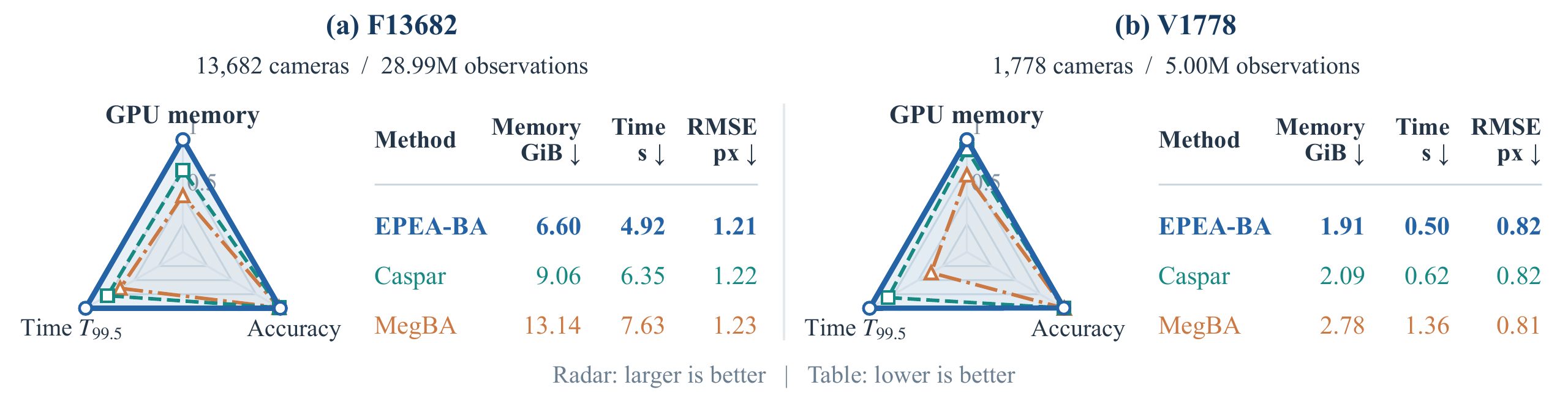
The benchmark uses the largest instance from each of five BAL families and fifteen 1DSfM reconstructions. Each solver runs once per scene in FP64 under a matched 10- or 30-second optimization budget. T99.5 measures time from the prepared initial state to the first accepted state that closes at least 99.5% of the initial pixel RMSE gap to a per-scene empirical reference fixed before timing.
- EPEA-BA
- 16 of 20 scenes
- MegBA
- 14 of 20 scenes
- Caspar
- 8 of 20 scenes
F13682, the largest BAL scene
13,682 cameras · 28.99 million observations. BAL problem data
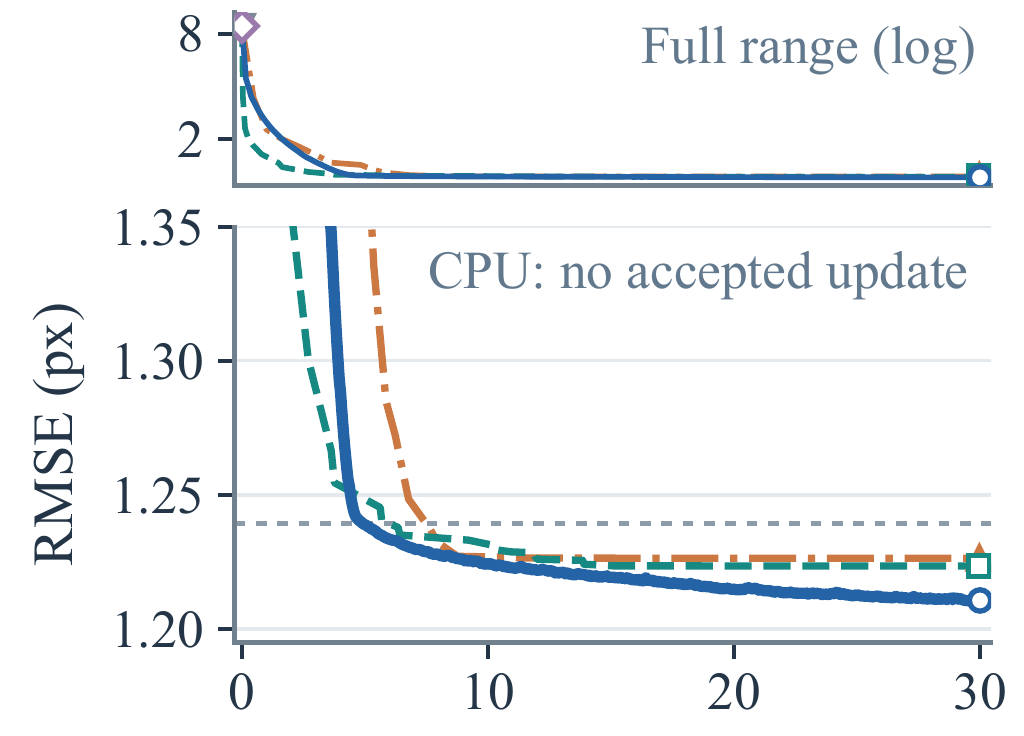
Accepted-state reprojection RMSE
Time to target and final RMSE within 30 s. EPEA-BA uses projection caching.
- EPEA-BA 4.92 s · 1.21 px
- MegBA 7.63 s · 1.23 px
- Caspar 6.35 s · 1.22 px
- 99.5% target
 Optimization time (s)
Peak GPU memory (GiB)
Median of three sampled process peaks
- EPEA-BA (cached)
- 6.60
- EPEA-BA (recomputed)
- 4.44
- Caspar
- 9.06
- MegBA (setup only)
- 13.14
Separate profiles used an earlier EPEA-BA camera-update configuration. The 30 s profiling budget includes preparation. MegBA’s peak covers preparation only.
Limitations
EPEA-BA refines initialized cameras and 3D tracks. The theoretical guarantees concern fixed linearizations in identifiable or retained directions. Changing geometry and poorly constrained views can still yield unstable steps. EPEA-BA missed the target on NYC Library within the tested budget, where MegBA reached it.
My Contributions
I started EPEA-BA at Westlake University.
- Theory
- I derived the error-transfer equations for both elimination orders, analyzed how viewing geometry can amplify camera rotation errors at distant points, and quantified local recovery on fixed linearizations.
- Algorithm design
- I designed the camera-first reduction and the closed-form curvature correction for Adam’s point updates.
- Engineering
- I implemented the GPU solver, including independent camera block solves and per-track aggregation of multi-view residuals.
- Experiments
- I evaluated the solver on 20 BAL and 1DSfM scenes and compared time to target and coverage with the GPU baselines under matched budgets.